


Will the Supreme Court gender case victors get the apologies they deserve?

This article appeared in The Spectator’s Coffee House on 17th April 2025.
Those who have won a great victory after years of struggle are entitled to enjoy a modest triumph, a single victory lap. But to crow too loudly is unseemly, and it is the mark of a small victor to pursue former opponents vindictively, taking vengeful advantage of new-found power to do so. An ugly object lesson is the small-minded man gleefully dominating American headlines today: a walking, talking, strutting, preening definition of how not to behave in victory.
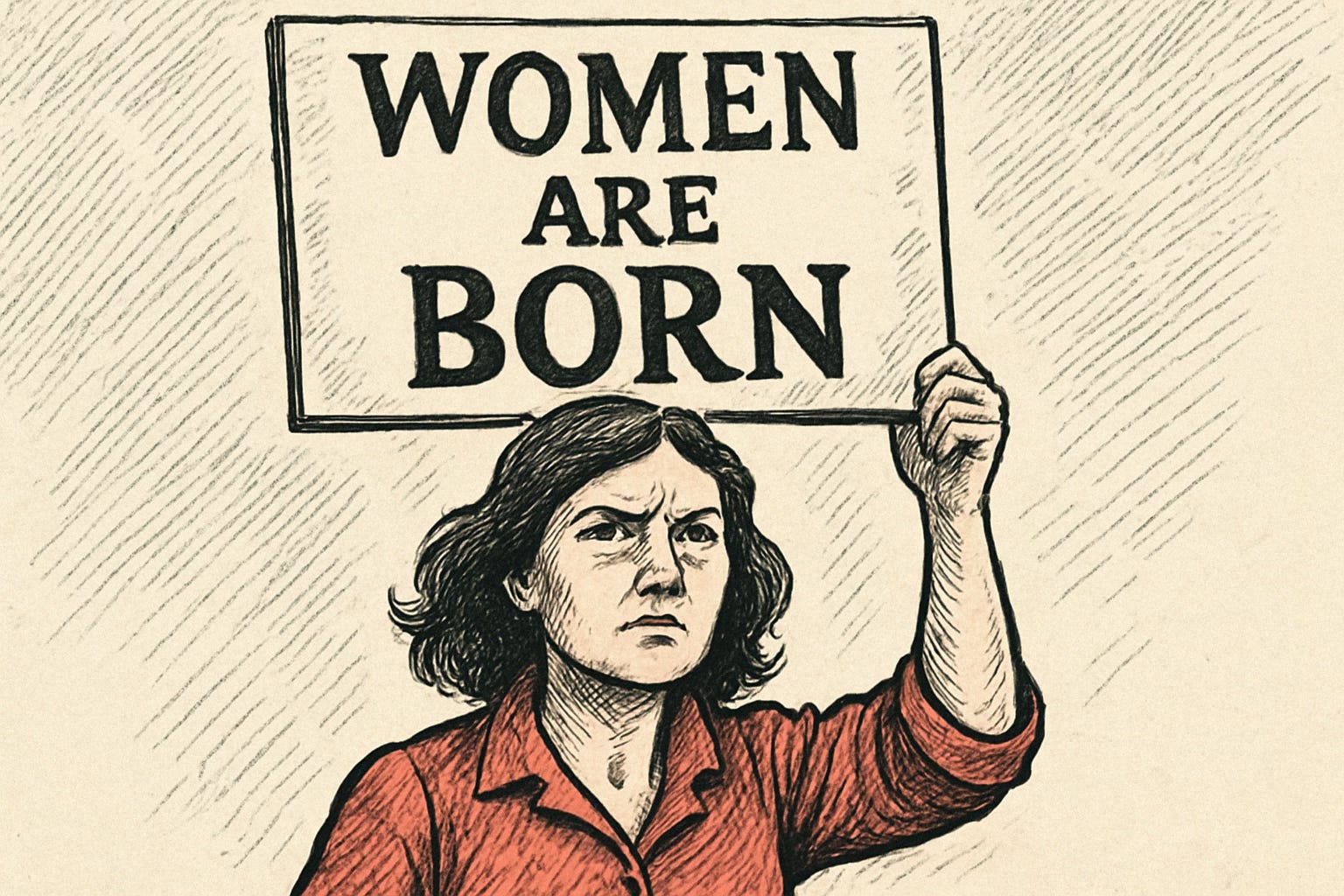
On 16 April, in London, the Supreme Court handed a stunning victory to those – mostly women – who have endured vilification, ruthless, relentless, sustained and vicious persecution, because they stood up for the obvious truth that a woman is an adult human female: the self-evident fact that a “trans woman” is a man, even if most have been too polite to say it in so many words.
The victors, and those of us who supported them, should not, and I think will not, turn on our opponents now licking their wounds. In particular, following the gracious lead of Lord Hodge, we should go easy on trans people themselves, who may be feeling forlorn if not worse. Even if we think them deluded, the deluded deserve sympathy. No decent person despises an anorexic who looks in the mirror and sees, contrary to all objective evidence, obesity. We should treat with the same gentle consideration the dysphoric who sees in the mirror the wrong genitals: who sincerely believes they were born “in the wrong body”, even believes, in honest befuddlement, that “trans women are women”.
So let us not name and shame. I shall call out no specific names in accusation. But I think apologies are called for, and there may be some out there who are big enough, gracious enough, to come forward.
Were you one of those students who mercilessly hounded Kathleen Stock out of the University of Sussex? Now would be a good time to say sorry. Were you one of those who threatened the life of JK Rowling? Or who threatened someone less able to look after herself than that redoubtable hero of our times? Were you one of those actors who owe your moment of fame entirely to her writing, who turned on her in your sheep-like devotion to a passing fad? Or were you one of those Hollywood airheads who bent to the prevailing political wind? Well, it isn’t prevailing any more, but mightn’t it have been a good idea to think the matter through in the first place, before joining the Gadarene stampede? In any case, a gracious apology wouldn’t come amiss.
Newspaper editors who printed reports of a “woman” committing rape “with her penis” should now apologise for their cowardly debauching of language. So should senior publishers who bowed to pressure to suppress books deemed “transphobic” by callow junior colleagues. By the way, if ever you are puzzled when an otherwise sensible friend starts spouting uncharacteristic nonsense on the subject of “gender”, your first recourse should be, “Cherchez les enfants”.
Those men of mediocre athletic ability who have waltzed into women’s events and effortlessly carried off their medals and plaudits, can be absolved of cheating only if they plead inability to understand the unfairness of their advantage. Those sports-body officials who enabled them should apologise to the women deprived of rightful medals, medals which should now be stripped from the men who unfairly gained them. Rather than respecting the subjective “gender” of the usurper, we should instead sympathise with the women overpowered by “her” objective sex, “her” upper body strength, long boxing reach, or sheer domineering height.
Are you one of those doctors who abetted angst-beset children, prescribing hormones whose unnatural and irreversible effects warrant the label “poison”? Or worse, are you a surgeon who violated the first Hippocratic principle by cutting off the breasts of a girl (or the testes of a boy) too young to be entrusted with drastic, irrevocably life-changing decisions? Admittedly, a public apology from you could lay you open to a well-deserved malpractice suit, but may you in any case be long pursued by remorse.
An especially magnanimous feat of forgiveness is required for those on the political left who betrayed their enlightenment heritage. Some honest leftists who wished to stay loyal to that heritage were thereby forced into unwilling temporary alliance with uncouth bedfellows on the right. With inevitable accusations of more general complicity – the most unkindest cut of all. I cannot help mentioning (while noting the honourable exception of the Center for Inquiry) those in my own small world of secular humanism, atheism, agnosticism, professional scepticism, who threw their rational principles (and their consistent colleagues and comrades) under the bus of fleeting fashion. But, more conspicuously, a public apology is owed by those left-leaning political leaders who delivered themselves of such gems as “A woman can quite clearly have a penis”. Or “Ninety nine per cent of women haven’t got a penis”. No sir, the figure you are groping for is “one hundred per cent”. If there’s one thing you can count on a woman to quite clearly not have, it is a penis.
The tragedy is that such obvious truths ever needed spelling out, or proclaiming in a high court of law. The biggest apology of all should come from those people of influence who fomented, or cravenly kowtowed to, the preposterous doctrine that something so fundamentally biological as the sexual binary is vulnerable to mere personal whim or legal documentation.
It’s amazing how the SC can give a ruling on the definition of sex in a specific law, and the immediate response is about transgender rights rather than the sex based rights of every individual. And RD is accused of being polemical!
The tone of this piece is entirely justified IMHO and I plan to share it as widely as possible
“Some honest leftists who wished to stay loyal to that heritage were thereby forced into unwilling temporary alliance with uncouth bedfellows on the right.” This right here describes my daily dilemma. Thank you for pointing this out.